

Flying-fox camps in Eurobodalla
At a glance
Flying-foxes are large native bats that feed on nectar, pollen, and fruit. They help to pollinate trees and spread seeds in forests and town areas.
Eurobodalla Council monitors nine grey-headed flying-fox camps across Eurobodalla and manages them under the Flying-Fox Management Plan. This plan helps protect bats. It also considers residents’ needs near homes, schools, and towns. Camps house grey-headed flying-foxes during the day, and at night they fly far to find nectar, pollen and fruit.
Residents living near bat camps can expect periods of noise, smell and droppings when bat numbers are high. Council provides resources and advice to affected residents.
We only move flying-fox camps in rare cases because it's expensive, difficult and often doesn't succeed. Moves can only take place with NSW and Australian Government approval, and outside the breeding season.
Why flying-fox camps form near towns
Flying-foxes look for shady trees like swamp oaks in floodplain forests. These forests are often endangered. Camps grow when trees produce lots of food, such as in 2016 when over 270,000 flying-foxes came to Batemans Bay. The number of bats changes with the seasons, usually peaking from December to May. As forest habitat and food decline, more flying-foxes are living and feeding in residential areas.
Grey-headed flying-fox camps in Eurobodalla
Council has monitored Eurobodalla's flying-fox camps since 2016.
See our interactive map to find camp locations.
Water Gardens camp - Batemans Bay township+
The Water Gardens is a six-hectare wetland park near Batemans Bay town centre. Council manages the park, and bats also roost on nearby private land. Flying-foxes often use the camp, but not every year.
Site and history
A community group opened the Water Gardens in 1999 and managed it first. The land was a natural drainage area and grazing site. Swamp oak floodplain forest - a protected endangered ecological community - covers the site. Council turned it into a town park in 1989. In 2012, Council started managing the site as vegetation grew near homes.
Flying-fox timeline
- 2012: Council first recorded grey-headed flying-foxes at the Water Gardens.
- 2013: The camp’s population went over 10,000.
- 2014: The population rose above 20,000.
- 2015: Council made a plan to manage the camp and removed overgrown vegetation at the Water Gardens to reinstate buffers between homes.
- 2016: Local trees flowered heavily and attracted hundreds of thousands of bats to Batemans Bay. Council made bigger buffer zones, removed weeds and rubbish, planted native plants, and added sprinklers to keep bats away from homes.
- 2016: Council started monitoring the camp after dispersal activities.
- 2018: Council created the wider Eurobodalla Flying-Fox Management Plan:
- 2019-2025: Bat numbers ranged from 0 to 16,000 at different times.
Northern Catalina camp - Club Catalina golf course+
Club Catalina golf course in Batemans Bay along Hanging Rock Creek hosts this camp. The camp grows in a swamp sclerophyll forest, another protected ecological area. The site is zoned for environmental conservation. Council began monitoring in 2012. Flying-foxes use the camp regularly but not every year. The camp covers almost 19ha.
Moruya central town camp+
Private land by Racecourse Creek near Moruya Showground hosts this camp. It has native and exotic plants. Flying-fox numbers reached 5,000 in 2023. Small groups have stayed there over recent years.
Moruya Heads camp+
This camp sits on private conservation land with swamp oak floodplain forest. The National Flying-Fox Monitoring Program counted 10,000 bats in 2013 and 2,000 in 2015. Council counted 13,000 in 2019. Bats use the camp sometimes.
Moruya Riverside Park camp+
Council owns this land and has planted native trees, including she-oaks. Flying-foxes began using the camp in December 2023. In May 2025, the population peaked at 14,000 and the camp covered about five hectares.
Moruya east town camp+
This private land near Racecourse Creek, southeast of the South Head Road roundabout, has swamp oak floodplain forest. The camp had 6,000 bats in 2023.
Tuross Head camp+
Vacant private land on Hector McWilliam Drive hosts this camp. The site supports yellow stringybark and coast grey box forest. Flying-foxes have been here since 2017. The camp covers about 1,500sq m. The National Flying-Fox Monitoring Program counted 100 bats in 2017. Numbers rose to 3,000 in 2019 but usually stay around 500.
Potato Point camp+
Eurobodalla National Park holds this camp near the town centre. The camp is in swamp-oak woodland and started in 2024 with up to 4,000 bats in April and 650 in July. It currently causes no problems for nearby residents.
Narooma camp+
The Narooma camp is on public conservation land covering 2.8ha. It features rainforest with lilly pilly and sassafras, another endangered forest type. The camp sits well away from homes. The camp peaked at 21,000 bats in mid-2022 but usually stays below 1,000.
How the camps compare and the 2016 flying-fox influx
Total population trends across all Eurobodalla camps+
Flying-fox influx in 2016+
In 2016, a rare mass flowering of spotted gums and red bloodwood trees attracted over 270,000 flying-foxes to Batemans Bay. The bats spread into residential areas and affected nearby residents.
How Council managed the camps
Council got permission from the Minister for the Environment to disperse flying-foxes and manage vegetation. We then prepared two key plans: the Eurobodalla Flying-Fox Management Plan and the Batemans Bay Flying-Fox Camp Dispersal Plan.
- Eurobodalla Flying-fox Management Plan (9.8 MB)
- Batemans Bay Flying-fox Camp Dispersal Plan 2016-2019 (2.8 MB)
In June and July 2016, Council reduced bat numbers by:
- removing 5.3ha of plants to create buffer zones
- clearing cocos palms to reduce mess
- planting native shrubs and grasses at the Water Gardens.
Maps show camp sizes at peaks in 2016 and 2019 and illustrate changes in bat numbers and camp area.
Click for larger images
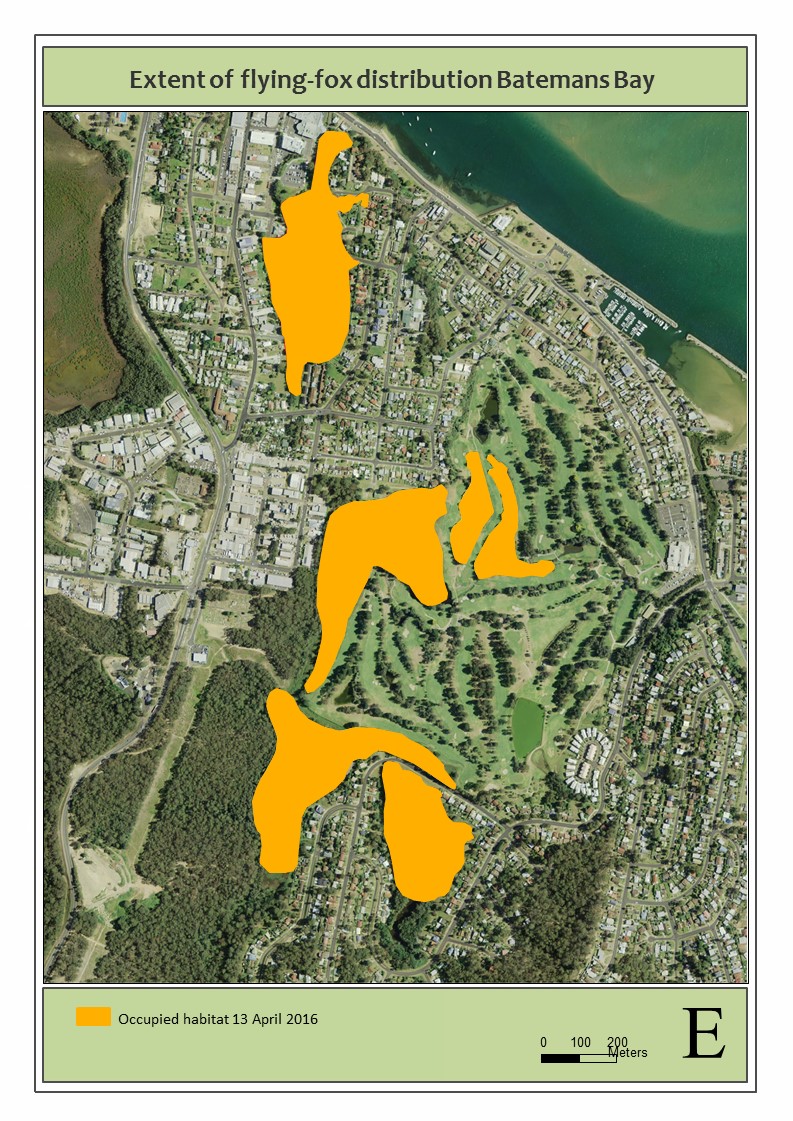
Flying-fox camps at their peak in April 2016
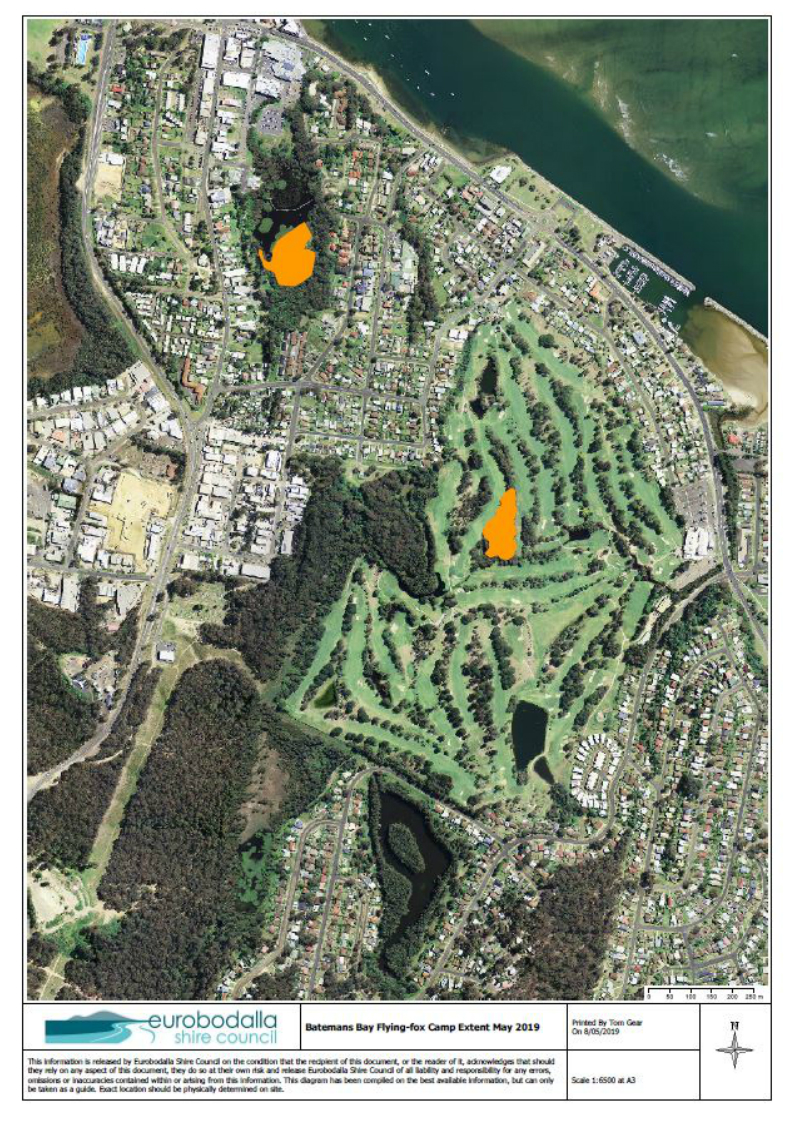
Flying-fox camps in Batemans Bay in May 2019
How Council manages flying-foxes
Council follows NSW rules to protect both flying-foxes and people. Key steps include:
- Monitor camps quarterly with the National Flying-fox Monitoring Program.
- Monitor camps more often when flying-fox numbers increase.
- Control weeds in flying-fox camps.
- Provide resources and advice to affected residents and continue to inform the community.
- Provide education resources on the important role of flying-foxes.
- Do not act on camps in remote locations or camps that cause little trouble.
Read the full Flying-Fox Management Plan:
Contact and further resources
For questions about grey-headed flying-foxes, contact:
To find out more about flying-foxes, contact:
- Council's Natural Resource Management Officer (Flying-Foxes), India Howlett:
- T: 02 4474 7329
- E: India Howlett
- Damon Oliver, Department of Climate Change, Energy, the Environment and Water:
- T: 02 6229 7112